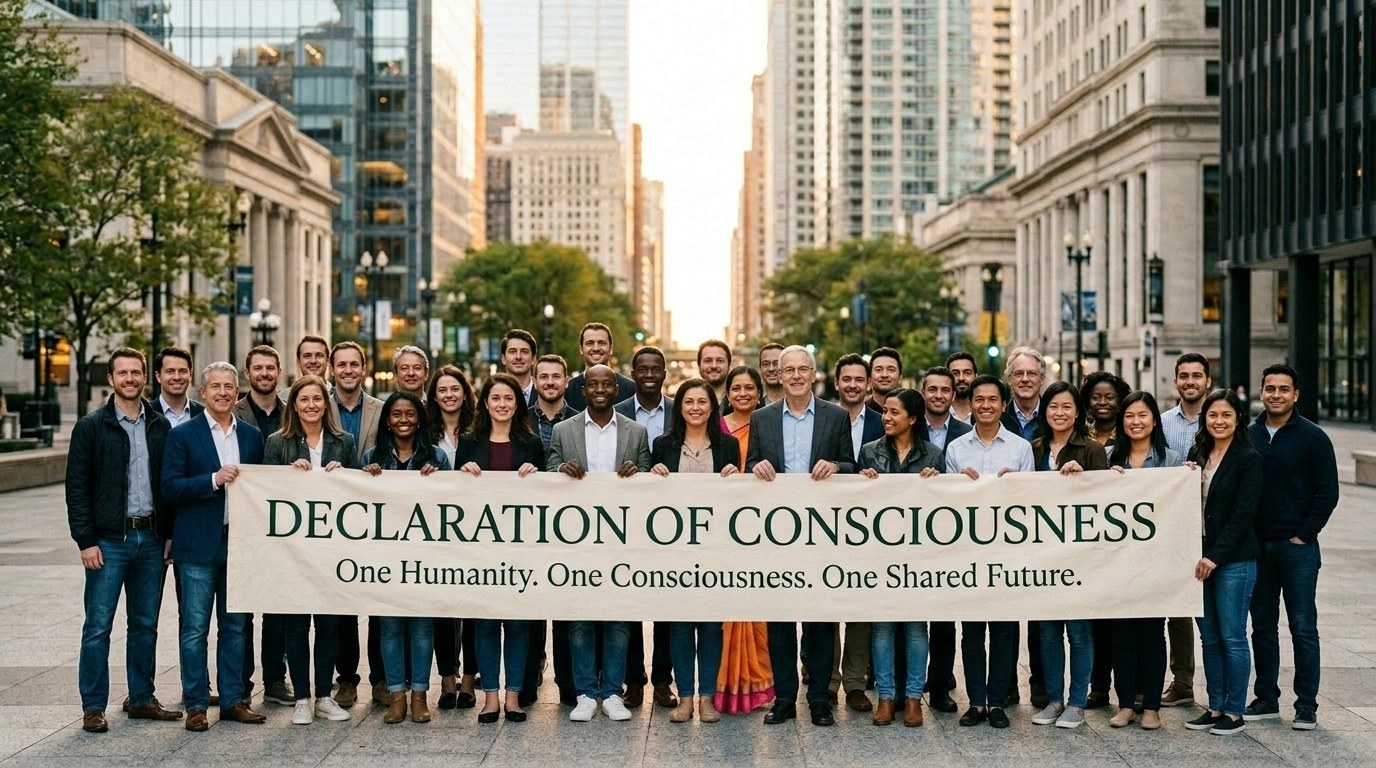
DoCM is a global, non-profit movement that helps people and institutions act from higher awareness. This is how it began — and the 9 Principles that guide where it's going.
The Origin
01
How a movement of awareness became a Declaration.
The Declaration of Consciousness Movement (DoCM) began with a simple observation — most of the world's hardest problems, from conflict to climate collapse, share one common root: a lack of consciousness in how we lead, work and live. DoCM turns that insight into a clear, global call to action anyone can join.
Why the Declaration Exists
02
Declarations have always moved history forward.
From human rights to climate accords, every major step forward began with a Declaration — a clear, public statement of values worth living by. DoCM's is a modern declaration that puts consciousness at the centre: a way of being and governing that honours every person, the planet, and a shared future.
Our Relationship with CNESS
03
Built on a decade of consciousness research.
DoCM works closely with CNESSWORKS, a global consciousness research and training body. Together, we translate insight into practical policy — building frameworks that governments, institutions and citizens can use to bring awareness into everyday decision-making.
DoCM's Global Role
04
From philosophy to practical peace.
DoCM convenes Global Councils, hosts the annual World Consciousness Day Summit on 11.11, and partners with universities, civic networks and cultural institutions to embed consciousness into how the world is run — making peace practical and progress humane.
The 9 Principles
The foundation of a conscious civilisation.
Nine principles guide the movement. Each one is practical — something you can live in your home, your workplace, your community, and your country. Jump to any principle to read it in full and see how to bring it to life.
Movement Whitepaper
Conscious Governance & Global Peace
This landmark DoCM whitepaper presents how leadership rooted in awareness and compassion can shape global peace — a framework of Conscious Governance aligned with Nobel ideals: peace, fraternity, and cooperation among nations. It carries the full 9 Principles, the global framework, and the pledge.
PDFFree for signatories
Reserved for signatories — we’ll check your email first.
01
Ahimsa — Non-violence & Animal Welfare
“In realizing our oneness with all life — human and animal alike — we grow compassionate, kind, and respectful toward every living being.”
For peace to prevail, humanity must embrace the law of coexistence — with every neighbour, every stranger, and every creature we share the Earth with. Peace is built one practical moment at a time.
Ahimsa starts at the kitchen table, the boardroom door, and every place a living being crosses our path — not at a treaty signing. It looks like a parent who chooses patience over a raised voice, a manager who hears a difficult truth without retaliating, a citizen who refuses to spread a rumour, a family that treats the animal in its care with the same dignity it would offer a guest. Building a non-violent society is the daily accumulation of small, deliberate choices: the apology offered first, the conflict de-escalated, the boundary held without aggression, the harm to any living being avoided. Governance follows culture — when households, workplaces, and communities normalise restraint and coexistence, institutions do too.
Why this principle matters
✦Reduces everyday harm in homes, schools, and workplaces
✦Extends compassion beyond humans — to animals and the ecosystems we share
✦Replaces escalation with dialogue, mediation, and coexistence
✦Breaks cycles of retaliation and instability
✦Builds trust where communities, employers, and governments meet
✦Makes peace measurable in policies, classrooms, and HR practices
Turn this principle into action
✦Diffuse a tense argument at home
✦Show kindness to an animal in need — feed, shelter, or protect
Equal pay, safe spaces, leadership at every table — every woman and girl deserves respect, freedom and full participation.
Women's rights become real in payroll data, in the design of public transport at night, in the composition of boards, in the speed at which a complaint is acted on. This principle asks for practical outcomes — not slogans. Audited wage parity. Safety infrastructure that women themselves help design. Childcare that lets careers continue. Health systems that treat women's bodies with research, care and respect. Where these conditions are met, families, economies, and democracies all grow stronger.
Why this principle matters
✦Closes pay and opportunity gaps at scale
✦Designs public spaces around safety — not as an afterthought
✦Brings women into leadership where decisions are made
✦Protects against gender-based violence with enforceable systems
✦Lifts entire economies when half the population can fully participate
Turn this principle into action
✦Advocate equal pay in your workplace
✦Mentor a girl or young woman
✦Support a women-led business or founder
03
Children's Welfare & Wellbeing
“Children deserve a world worthy of their future.”
Safe schools, fair access to learning, and protection from harm — childhood is the foundation of every nation.
A society's commitment to children is measured by the schools it funds, the food it ensures, the violence it prevents, and the digital harms it regulates. This principle is practical: classrooms with enough teachers, playgrounds that are safe, healthcare for the first 1,000 days of life, and laws that take child protection out of the realm of charity and into the realm of public duty. Every adult — parent, teacher, employer, lawmaker — carries some of this weight.
Why this principle matters
✦Builds healthier, more resilient adults — and economies
✦Reduces inequality at the point where it compounds fastest
✦Protects children from violence, exploitation and digital harm
✦Strengthens schools, family support and public health systems
✦Secures intergenerational peace by investing where it lasts longest
Honoring our elders is a conscious act of respect, gratitude, and inclusion.
Elders play an essential role as carriers of wisdom, memory, and intergenerational perspective. Honoring elders means valuing their voices, ensuring their wellbeing, and including them in decision-making processes where their insights can guide younger generations. Conscious societies recognise that elders require support — healthcare, respect, security, and companionship.
Why this principle matters
✦Preserves historical memory and cultural continuity
✦Strengthens empathy and intergenerational respect
✦Supports social stability and shared wisdom
✦Upholds respect and protection for vulnerable adults
✦Encourages long-term thinking in policy and society
Every human carries equal worth. Inclusion and right action are the proof of our shared humanity.
Equality affirms that no individual or group is inherently superior or inferior. It is realised through three inseparable commitments: equity (every person treated as fully human), inclusivity (every voice given a real seat at the table — across race, gender, ability, faith, and identity), and righteousness (the discipline to do what is right even when it is not convenient). Conscious governance demands transparent systems that prevent bias, embed inclusion into institutions, and protect every individual — encouraging leaders to dismantle barriers that restrict growth, and to choose conscious action over expedient action.
Why this principle matters
✦Reduces conflict rooted in discrimination or inequality
✦Embeds inclusivity as a working practice, not a slogan
✦Holds institutions to the standard of righteousness — doing what is right
✦Strengthens fair access to opportunities and justice
✦Builds cohesive, resilient societies that honour every member
Every conscious action begins with the freedom to think independently.
Freedom of thought, speech, and expression is essential for human progress. It nurtures creativity, innovation, scientific advancement, cultural diversity, and democratic participation. In governance, it encourages accountability, transparency, and constructive criticism. For communities, it enables cultural evolution, intellectual exchange, and deeper understanding between groups.
Why this principle matters
✦Enables innovation, culture, and intellectual growth
✦Encourages transparent, accountable leadership
✦Reduces fear-based conflict
✦Strengthens democratic values and human agency
✦Creates room for dialogue in diverse societies
Turn this principle into action
✦Publish a considered idea or perspective
✦Support a writer, artist or teacher
✦Defend someone's right to disagree with you
07
Conscious Organisations
“Responsible organisations shape a responsible world.”
Organisations must act consciously, responsibly, and sustainably, contributing to the wellbeing of people and the planet.
Conscious organisations operate with awareness of their impact on employees, communities, and the environment. They prioritise conscious decision-making, fairness, safety, transparency, and sustainability alongside financial performance. Conscious governance calls for institutions — public or private — to adopt practices that reduce harm, promote wellbeing, and create value responsibly.
Why this principle matters
✦Ensures conscious, fair, and responsible operations
✦Builds trust between people, institutions, and society
Humanity must protect and restore the planet through sustainable choices and collective responsibility.
The wellbeing of the planet is the foundation for all life. Climate change, biodiversity loss, pollution, and resource depletion threaten global peace by creating displacement, scarcity, and conflict. Sustainable environmental action is not optional — it is an urgent shared responsibility. Conscious governance requires decisions that honour ecological boundaries.
Why this principle matters
✦Prevents conflict driven by resource scarcity
✦Protects ecosystems that sustain life
✦Reduces climate-related instability and displacement
Our differences exist within a shared human fabric — cooperation is stronger than division.
Unity for All does not ask everyone to be the same; it calls us to recognise that diversity lives within a single human family. This principle affirms that people of different cultures, beliefs, identities, and backgrounds can coexist with respect while working toward shared goals. Unity is the choice to prioritise connection over separation, collaboration over competition.
Why this principle matters
✦Reduces polarization and 'us vs. them' narratives
✦Strengthens social cohesion and mutual trust
✦Encourages collaboration across cultures, beliefs, and identities
✦Supports peaceful conflict resolution and shared problem-solving
✦Builds a sense of shared purpose at local, national, and global levels
Turn this principle into action
✦Have a friendly conversation across cultural lines
✦Join or organise an inter-community event
✦Refuse to share a divisive post
Turn the Principles Into Action
Declare consciousness in your thoughts, words and everyday actions.
Signing the Declaration is a personal commitment to live by these nine principles — and to help the world move toward a more conscious future.
I commit to
✦Choosing non-violence, compassion, and respectful dialogue.
✦Honouring the equal worth, integrity, and rights of every human being.
✦Respecting freedom of thought, speech, and expression — acting responsibly.
✦Supporting the safety, equality, and empowerment of women.
✦Protecting and nurturing the wellbeing, development, and future of children.
✦Respecting and valuing the wisdom, integrity, and contributions of elders.
✦Acting consciously in every community I serve.
✦Caring for Mother Earth through sustainable choices and collective responsibility.
✦Embracing our shared humanity — building unity across cultures, beliefs, and backgrounds.
“I choose awareness over division, cooperation over conflict, responsibility over indifference.”
The Declaration makes consciousness a universal principle for human progress. In a world shaped by complexity, conflict and fragmentation, it points us back to our greatest strength — the ability to choose how we act.
01
Peace Diplomacy & Global Dialogues
Facilitating international conversations and conflict resolution forums rooted in awareness.
02
Education & Cultural Transformation
Supporting consciousness-based learning programs, academic partnerships, and youth engagement initiatives.
03
Consciousness Research & Frameworks
Developing and publishing global frameworks that define consciousness in leadership, governance, and culture.
04
Planetary & Governance Awareness
Advancing research and dialogue in conscious governance, environmental responsibility, and conscious leadership.
Be part of the next chapter.
Add your name to the Declaration and stand with 4,525 signatories across 50 nations.