
Declare your Random Acts of Consciousness.
Uplift Humanity.
Join a global call for higher thoughts, compassionate actions, and conscious living. On 08·08 Consciousness Day for Humanity, pledge to perform one Random Act of Consciousness.
Or get the Conscious Super AppBring a conscious act to life.
One question. Two doors. Both add to the Wall of Consciousness.
Perform a Random Act of Consciousness
For individuals who want to perform one conscious action and share it with the world.
- ✦Help someone in need
- ✦Feed an animal
- ✦Plant a tree
- ✦Support an elderly person
- ✦Mentor a student
- ✦Express gratitude
Create a Consciousness Event
For people, communities, schools or organisations who want to organise a collective act of consciousness.
- ✦Visit an elderly home
- ✦Organise a beach cleanup
- ✦Plant trees together
- ✦Feed people in need
- ✦Mentor students
- ✦Community service
What people are doing right now.
“Fleming's accidental discovery of penicillin in 1928 reshaped medicine. Through the war years he worked with Florey and Chain to scale production, but consistently refused personal commercial control of the antibiotic. He warned, presciently, against the careless overuse that would breed resistance. Today antibiotics derived from his discovery are estimated to have saved more than 200 million lives — a quiet harvest from a discovery he chose not to fence off.”
“A physicist by training, Vandana Shiva founded Navdanya in 1987 — a seed-saving network that today preserves more than 5,000 traditional Indian crop varieties across 22 community seed banks. She has trained over a million farmers in organic, biodiverse practice, and used the courts and the public square to challenge bio-piracy of indigenous knowledge. Her quiet thesis: that what feeds a people should belong to them.”
“On 7 March 1965, twenty-five-year-old John Lewis led 600 civil-rights marchers across the Edmund Pettus Bridge in Selma, Alabama. State troopers met them with clubs and tear gas; Lewis's skull was fractured. Images of the violence shocked the country and led directly to the Voting Rights Act later that year. Lewis spent the next half-century in Congress, repeating the same line: 'Get in good trouble. Necessary trouble.'”
“After isolating radium in 1898 alongside Pierre Curie, Marie Curie was urged to patent the process and become wealthy. She refused. 'Radium is not to enrich anyone,' she said. 'It is an element; it belongs to all people.' During the First World War she equipped twenty mobile X-ray units and drove them to the front herself, treating more than a million wounded soldiers. Two Nobel Prizes followed; she kept living modestly until radiation poisoning took her in 1934.”
“Frederick Douglass taught himself to read as a child held in bondage, escaped at twenty, and became the most photographed American of the 19th century. His autobiographies — first published in 1845 — were so direct, so unmistakably the work of a free thinking mind, that they undid slavery's defenders by their existence alone. He advised Abraham Lincoln, argued for women's suffrage at Seneca Falls, and never stopped speaking the obvious truth that the abolitionists were merely catching up to.”
“At eleven Malala Yousafzai was already writing for the BBC under a pseudonym about life under Taliban rule in the Swat Valley. At fifteen, on 9 October 2012, she was shot in the head on her school bus. She survived, recovered in Birmingham, and addressed the United Nations on her sixteenth birthday: 'One child, one teacher, one book, one pen can change the world.' The Malala Fund she founded supports girls' education in countries where it remains contested.”
“An independent scientist working largely outside the university system, James Lovelock proposed the Gaia hypothesis in the early 1970s: that the Earth's biosphere, oceans and atmosphere together behave as a single self-regulating system. Mainstream science resisted; over decades the hypothesis matured into Earth System Science. Beyond the equations, Lovelock had given the world a sentence — Earth is alive — that changed how millions thought about their responsibility to it.”
“A young Harvard-trained lawyer who chose Montgomery, Alabama, over Wall Street, Bryan Stevenson founded the Equal Justice Initiative in 1989. His team has won relief for more than 140 wrongly condemned death-row prisoners, fought to ban juvenile life-without-parole, and built the Legacy Museum and National Memorial for Peace and Justice to confront the history of lynching. His thesis: 'Each of us is more than the worst thing we've ever done.'”
“On 5 November 1872, Susan B. Anthony walked into a polling station in Rochester, New York, and cast a ballot for Ulysses S. Grant. Two weeks later she was arrested. At trial she refused to pay the hundred-dollar fine and used the courtroom as a platform to argue that the Fourteenth Amendment already guaranteed her right. She did not live to see the Nineteenth Amendment ratified in 1920, but it was popularly called the Anthony Amendment because of her.”
“Born into slavery as Isabella Baumfree, freed at forty, she renamed herself Sojourner Truth and became one of the most powerful itinerant preachers and abolitionists of her century. At the 1851 Women's Rights Convention in Akron, Ohio, she rose unscheduled and delivered the speech later remembered as 'Ain't I a Woman?' — confronting an audience that wanted women's rights for white women only. She was unlettered, six feet tall, and the moral centre of the room.”
“A government biologist and lyrical writer, Rachel Carson watched the post-war chemical industry promise abundance while songbirds quietly died. Already ill with cancer, she chose to publish 'Silent Spring' in 1962, documenting how DDT was poisoning ecosystems from soil to mother's milk. The chemical industry attacked her. She testified before the U.S. Senate anyway. Her work led to DDT's ban, the creation of the EPA, and the beginning of ecological conscience as public policy.”
“On 1 December 1955, Rosa Parks — a 42-year-old seamstress and longtime NAACP secretary — refused to give up her seat on a Montgomery bus to a white passenger. Her arrest triggered the 381-day Montgomery Bus Boycott led by a young Martin Luther King Jr., and a 1956 Supreme Court ruling that segregated buses were unconstitutional. The act looked small. It was the work of a lifetime of preparation — and it changed America.”
“A German Lutheran pastor and theologian, Dietrich Bonhoeffer publicly opposed the Nazi co-option of the German church from the moment Hitler took power in 1933. He helped found the Confessing Church, ran an underground seminary, and later joined a circle that plotted to remove Hitler. Imprisoned in 1943 and executed at Flossenbürg on 9 April 1945, two weeks before the camp was liberated, his prison letters became one of the 20th century's most studied texts on conscience.”
“When the polio vaccine Jonas Salk developed was announced in 1955, it could have made him one of the richest people alive. In a televised interview Edward R. Murrow asked who held the patent. 'Well, the people, I would say,' Salk answered. 'There is no patent. Could you patent the sun?' His refusal made the vaccine freely available; polio cases collapsed by 90% within five years. Conscience, in his hands, was a public-health intervention.”
“Sophie Scholl was a twenty-one-year-old biology student when she joined her brother Hans and a small group of friends in writing and circulating the White Rose leaflets — six anti-Nazi tracts that called for resistance from within Germany itself. On 18 February 1943 she was caught scattering the sixth leaflet from a balcony at the University of Munich. Four days later she was guillotined. Her last recorded words: 'How can we expect righteousness to prevail when there is hardly anyone willing to give themselves up individually?'”
“In 1990 Carl Sagan persuaded NASA to turn Voyager 1's camera back toward Earth from beyond Neptune. The photograph showed our planet as a single pale blue pixel in a sunbeam. Sagan's accompanying meditation — that every saint and sinner, every war and love story unfolds on that dot — became one of the most quoted scientific texts of the century. His life's work was the conscious habit of seeing ourselves from far enough away to notice we are one species.”
“The son of migrant farm workers, César Chávez co-founded the United Farm Workers and in 1965 led the Delano Grape Strike — a five-year non-violent protest that drew seventeen million Americans into a boycott of California table grapes. He fasted for twenty-five days in 1968 to reaffirm the movement's commitment to non-violence. The 1970 agreement won the first union contracts for American farm workers and reshaped agricultural labour rights.”
“Across seven decades and dozens of landmark series, David Attenborough chose to be the patient narrator of a living planet most viewers would never see. He filmed in 39 countries before his ninetieth birthday and, in his later years, turned that authority unambiguously toward the climate crisis. His public testimonies at the UN and at COP summits, delivered without rhetorical flourish, gave moral weight to evidence-based climate action.”
“A Viennese psychiatrist deported with his wife and parents to Theresienstadt in 1942 and later to Auschwitz, Viktor Frankl lost almost his entire family. He spent the years in the camps quietly observing which prisoners survived and why — and concluded it was almost always those who had something to live for. Freed in April 1945, he wrote 'Man's Search for Meaning' in nine days. Logotherapy, the school he founded, taught that humans can endure almost any 'how' if they have a 'why'.”
“Simone Weil was a top graduate of the École Normale Supérieure who chose to leave the academy to take factory jobs in Renault plants in 1934 — not as an observer but as a worker on the line. She fought briefly in the Spanish Civil War, joined the French Resistance from London, and starved herself to the rations of occupied France until her death in 1943, aged thirty-four. 'Attention,' she wrote, 'is the rarest and purest form of generosity.'”
“A German-Jewish political theorist who escaped Nazi Europe in 1941, Hannah Arendt covered Adolf Eichmann's 1961 trial in Jerusalem for The New Yorker. Watching the man who organised the deportation of millions, she expected monstrous evil — and instead found a thoughtless bureaucrat. Her phrase 'the banality of evil' was widely misread as exoneration. She meant the opposite: that the failure to think — to refuse one's own complicity — is itself the machinery of atrocity.”
“After a friend was lynched in Memphis, Ida B. Wells began travelling the American South investigating cases, interviewing witnesses, and publishing meticulously documented pamphlets — 'Southern Horrors' (1892) and 'A Red Record' (1895) — that turned vague rumour into legible data. Her press was destroyed by a mob; she carried on from Chicago, helped found the NAACP, and pioneered investigative journalism as an instrument of conscience.”
“Harriet Tubman escaped slavery in 1849 and could have lived out her life in free Pennsylvania. Instead she returned to Maryland thirteen times across the following decade, leading approximately seventy enslaved people — including her own family — north to freedom along what came to be called the Underground Railroad. During the Civil War she served as scout, spy and nurse, leading an armed raid that liberated more than 700 enslaved people in a single night. She never lost a passenger.”
“Without academic credentials but with extraordinary patience, Jane Goodall arrived at Gombe Stream in 1960 and spent months waiting for the chimpanzees to accept her presence. She named them, observed tool use long thought exclusive to humans, and proved that quiet attention is a form of science. Her later decades of conservation advocacy and the Roots & Shoots youth programme show that consciousness, for her, was always the same act: paying attention to another life on its own terms.”
“Fleming's accidental discovery of penicillin in 1928 reshaped medicine. Through the war years he worked with Florey and Chain to scale production, but consistently refused personal commercial control of the antibiotic. He warned, presciently, against the careless overuse that would breed resistance. Today antibiotics derived from his discovery are estimated to have saved more than 200 million lives — a quiet harvest from a discovery he chose not to fence off.”
“A physicist by training, Vandana Shiva founded Navdanya in 1987 — a seed-saving network that today preserves more than 5,000 traditional Indian crop varieties across 22 community seed banks. She has trained over a million farmers in organic, biodiverse practice, and used the courts and the public square to challenge bio-piracy of indigenous knowledge. Her quiet thesis: that what feeds a people should belong to them.”
“On 7 March 1965, twenty-five-year-old John Lewis led 600 civil-rights marchers across the Edmund Pettus Bridge in Selma, Alabama. State troopers met them with clubs and tear gas; Lewis's skull was fractured. Images of the violence shocked the country and led directly to the Voting Rights Act later that year. Lewis spent the next half-century in Congress, repeating the same line: 'Get in good trouble. Necessary trouble.'”
“After isolating radium in 1898 alongside Pierre Curie, Marie Curie was urged to patent the process and become wealthy. She refused. 'Radium is not to enrich anyone,' she said. 'It is an element; it belongs to all people.' During the First World War she equipped twenty mobile X-ray units and drove them to the front herself, treating more than a million wounded soldiers. Two Nobel Prizes followed; she kept living modestly until radiation poisoning took her in 1934.”
“Frederick Douglass taught himself to read as a child held in bondage, escaped at twenty, and became the most photographed American of the 19th century. His autobiographies — first published in 1845 — were so direct, so unmistakably the work of a free thinking mind, that they undid slavery's defenders by their existence alone. He advised Abraham Lincoln, argued for women's suffrage at Seneca Falls, and never stopped speaking the obvious truth that the abolitionists were merely catching up to.”
“At eleven Malala Yousafzai was already writing for the BBC under a pseudonym about life under Taliban rule in the Swat Valley. At fifteen, on 9 October 2012, she was shot in the head on her school bus. She survived, recovered in Birmingham, and addressed the United Nations on her sixteenth birthday: 'One child, one teacher, one book, one pen can change the world.' The Malala Fund she founded supports girls' education in countries where it remains contested.”
“An independent scientist working largely outside the university system, James Lovelock proposed the Gaia hypothesis in the early 1970s: that the Earth's biosphere, oceans and atmosphere together behave as a single self-regulating system. Mainstream science resisted; over decades the hypothesis matured into Earth System Science. Beyond the equations, Lovelock had given the world a sentence — Earth is alive — that changed how millions thought about their responsibility to it.”
“A young Harvard-trained lawyer who chose Montgomery, Alabama, over Wall Street, Bryan Stevenson founded the Equal Justice Initiative in 1989. His team has won relief for more than 140 wrongly condemned death-row prisoners, fought to ban juvenile life-without-parole, and built the Legacy Museum and National Memorial for Peace and Justice to confront the history of lynching. His thesis: 'Each of us is more than the worst thing we've ever done.'”
“On 5 November 1872, Susan B. Anthony walked into a polling station in Rochester, New York, and cast a ballot for Ulysses S. Grant. Two weeks later she was arrested. At trial she refused to pay the hundred-dollar fine and used the courtroom as a platform to argue that the Fourteenth Amendment already guaranteed her right. She did not live to see the Nineteenth Amendment ratified in 1920, but it was popularly called the Anthony Amendment because of her.”
“Born into slavery as Isabella Baumfree, freed at forty, she renamed herself Sojourner Truth and became one of the most powerful itinerant preachers and abolitionists of her century. At the 1851 Women's Rights Convention in Akron, Ohio, she rose unscheduled and delivered the speech later remembered as 'Ain't I a Woman?' — confronting an audience that wanted women's rights for white women only. She was unlettered, six feet tall, and the moral centre of the room.”
“A government biologist and lyrical writer, Rachel Carson watched the post-war chemical industry promise abundance while songbirds quietly died. Already ill with cancer, she chose to publish 'Silent Spring' in 1962, documenting how DDT was poisoning ecosystems from soil to mother's milk. The chemical industry attacked her. She testified before the U.S. Senate anyway. Her work led to DDT's ban, the creation of the EPA, and the beginning of ecological conscience as public policy.”
“On 1 December 1955, Rosa Parks — a 42-year-old seamstress and longtime NAACP secretary — refused to give up her seat on a Montgomery bus to a white passenger. Her arrest triggered the 381-day Montgomery Bus Boycott led by a young Martin Luther King Jr., and a 1956 Supreme Court ruling that segregated buses were unconstitutional. The act looked small. It was the work of a lifetime of preparation — and it changed America.”
“A German Lutheran pastor and theologian, Dietrich Bonhoeffer publicly opposed the Nazi co-option of the German church from the moment Hitler took power in 1933. He helped found the Confessing Church, ran an underground seminary, and later joined a circle that plotted to remove Hitler. Imprisoned in 1943 and executed at Flossenbürg on 9 April 1945, two weeks before the camp was liberated, his prison letters became one of the 20th century's most studied texts on conscience.”
“When the polio vaccine Jonas Salk developed was announced in 1955, it could have made him one of the richest people alive. In a televised interview Edward R. Murrow asked who held the patent. 'Well, the people, I would say,' Salk answered. 'There is no patent. Could you patent the sun?' His refusal made the vaccine freely available; polio cases collapsed by 90% within five years. Conscience, in his hands, was a public-health intervention.”
“Sophie Scholl was a twenty-one-year-old biology student when she joined her brother Hans and a small group of friends in writing and circulating the White Rose leaflets — six anti-Nazi tracts that called for resistance from within Germany itself. On 18 February 1943 she was caught scattering the sixth leaflet from a balcony at the University of Munich. Four days later she was guillotined. Her last recorded words: 'How can we expect righteousness to prevail when there is hardly anyone willing to give themselves up individually?'”
“In 1990 Carl Sagan persuaded NASA to turn Voyager 1's camera back toward Earth from beyond Neptune. The photograph showed our planet as a single pale blue pixel in a sunbeam. Sagan's accompanying meditation — that every saint and sinner, every war and love story unfolds on that dot — became one of the most quoted scientific texts of the century. His life's work was the conscious habit of seeing ourselves from far enough away to notice we are one species.”
“The son of migrant farm workers, César Chávez co-founded the United Farm Workers and in 1965 led the Delano Grape Strike — a five-year non-violent protest that drew seventeen million Americans into a boycott of California table grapes. He fasted for twenty-five days in 1968 to reaffirm the movement's commitment to non-violence. The 1970 agreement won the first union contracts for American farm workers and reshaped agricultural labour rights.”
“Across seven decades and dozens of landmark series, David Attenborough chose to be the patient narrator of a living planet most viewers would never see. He filmed in 39 countries before his ninetieth birthday and, in his later years, turned that authority unambiguously toward the climate crisis. His public testimonies at the UN and at COP summits, delivered without rhetorical flourish, gave moral weight to evidence-based climate action.”
“A Viennese psychiatrist deported with his wife and parents to Theresienstadt in 1942 and later to Auschwitz, Viktor Frankl lost almost his entire family. He spent the years in the camps quietly observing which prisoners survived and why — and concluded it was almost always those who had something to live for. Freed in April 1945, he wrote 'Man's Search for Meaning' in nine days. Logotherapy, the school he founded, taught that humans can endure almost any 'how' if they have a 'why'.”
“Simone Weil was a top graduate of the École Normale Supérieure who chose to leave the academy to take factory jobs in Renault plants in 1934 — not as an observer but as a worker on the line. She fought briefly in the Spanish Civil War, joined the French Resistance from London, and starved herself to the rations of occupied France until her death in 1943, aged thirty-four. 'Attention,' she wrote, 'is the rarest and purest form of generosity.'”
“A German-Jewish political theorist who escaped Nazi Europe in 1941, Hannah Arendt covered Adolf Eichmann's 1961 trial in Jerusalem for The New Yorker. Watching the man who organised the deportation of millions, she expected monstrous evil — and instead found a thoughtless bureaucrat. Her phrase 'the banality of evil' was widely misread as exoneration. She meant the opposite: that the failure to think — to refuse one's own complicity — is itself the machinery of atrocity.”
“After a friend was lynched in Memphis, Ida B. Wells began travelling the American South investigating cases, interviewing witnesses, and publishing meticulously documented pamphlets — 'Southern Horrors' (1892) and 'A Red Record' (1895) — that turned vague rumour into legible data. Her press was destroyed by a mob; she carried on from Chicago, helped found the NAACP, and pioneered investigative journalism as an instrument of conscience.”
“Harriet Tubman escaped slavery in 1849 and could have lived out her life in free Pennsylvania. Instead she returned to Maryland thirteen times across the following decade, leading approximately seventy enslaved people — including her own family — north to freedom along what came to be called the Underground Railroad. During the Civil War she served as scout, spy and nurse, leading an armed raid that liberated more than 700 enslaved people in a single night. She never lost a passenger.”
“Without academic credentials but with extraordinary patience, Jane Goodall arrived at Gombe Stream in 1960 and spent months waiting for the chimpanzees to accept her presence. She named them, observed tool use long thought exclusive to humans, and proved that quiet attention is a form of science. Her later decades of conservation advocacy and the Roots & Shoots youth programme show that consciousness, for her, was always the same act: paying attention to another life on its own terms.”
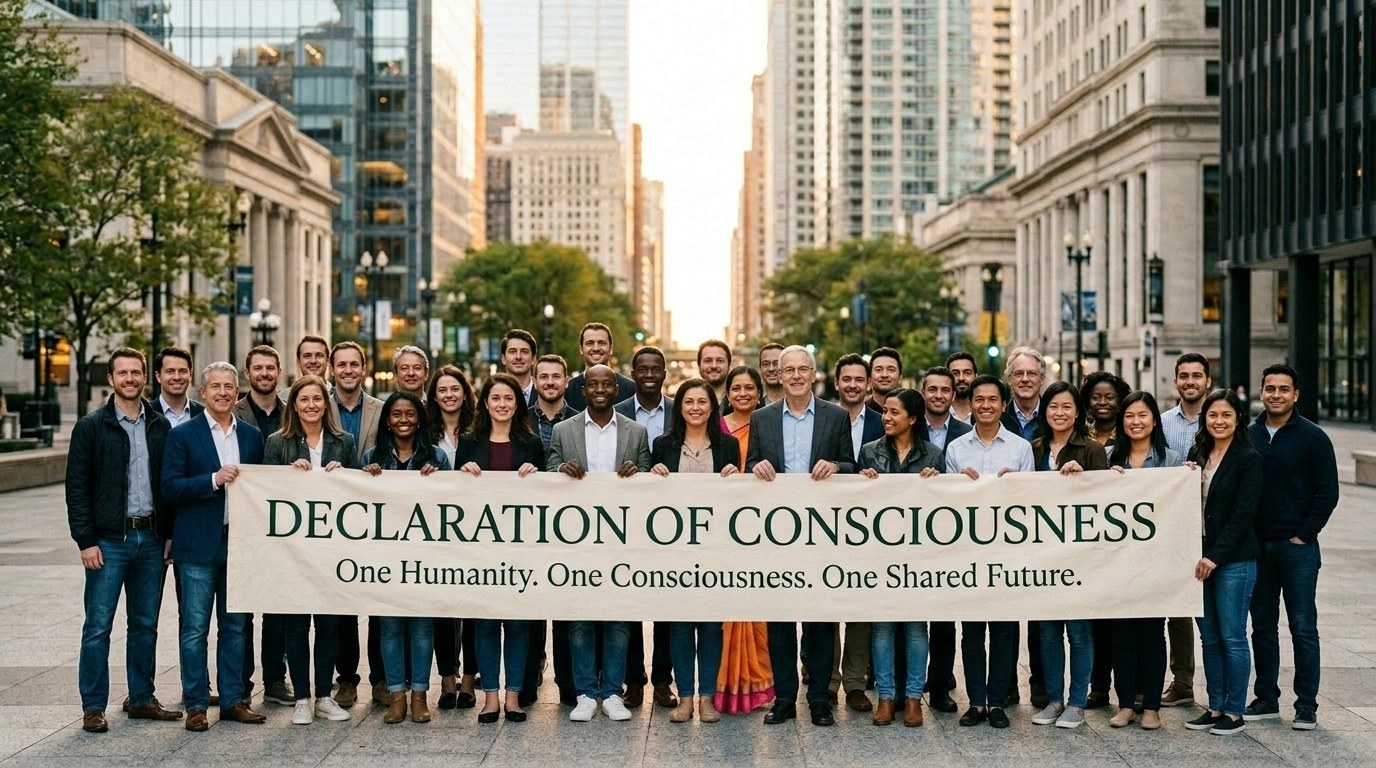
A declaration for the age of consciousness.
In 1776, the Declaration of Independence voiced a nation’s aspired fight for freedom. Today, the world calls for a larger manifesto — the Declaration of Consciousness Movement — upholding nonviolence, women’s rights, equality, inclusivity, righteousness, freedom of thought, unity of all religions, planet earth as the intrinsic inherent rights of every human across cultures and all nations.
The foundation of a conscious civilisation.
Nine principles, one shared compass. The Declaration of Consciousness responds to humanity’s fundamental need for peace, unity, and belonging in a changing world. Together, these principles celebrate all dimensions of consciousness and translate awareness into everyday action — from the worth of one person to the responsibility of an entire planet.
Hover or tap a segment to read each principle. Click through for the full essay.
One conscious civilisation.
08·08
The Global Day of Consciousness.
One date. Every time zone. One shared call to action. On 08·08, the world is invited to pause — and to perform a single conscious act. Together, these simple acts activate the Declaration of Consciousness and turn awareness into a shared future.
A Random Act of Consciousness.
The act of 08·08.
Small intentional actions, multiplied globally, create meaningful change for people, society and the planet. Choose your act. Document it. Inspire someone else to do theirs. Together — we move from awareness to action.
Begin with a declaration.
Before any act, there is an intention. By signing the Declaration of Consciousness, you affirm a shared foundation: nine universal principles for a more humane, awake world.
Begin with a declaration.
Before any act, there is an intention. By signing the Declaration of Consciousness, you affirm a shared foundation: nine universal principles for a more humane, awake world.